
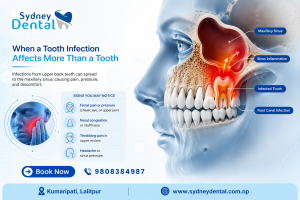
Many people experience recurring sinus infections, facial pressure, or gum swelling and assume they’re unrelated problems. In reality, a hidden dental infection especially in an upper back tooth can sometimes be the underlying cause.
At Sydney Dental, we’ve treated patients who spent months or even years managing sinus symptoms without realizing the source was an infected tooth. One patient’s experience highlights why persistent symptoms should never be ignored.
A Real Patient Story
A patient came to Sydney Dental after experiencing recurring swelling in the gums around a tooth that had undergone Root Canal Treatment (RCT) several years earlier.
Although the swelling would come and go, they had been told by other dentists that it was “normal” after a root canal. Despite this reassurance, the problem never truly resolved.
During a comprehensive examination, Dr. Shakti carefully assessed the tooth using clinical evaluation and dental X-rays. The diagnosis revealed that the previous root canal treatment had not completely eliminated the infection. Some bacteria had remained inside the root canal system, causing a chronic infection.
Instead of extracting the tooth, Dr. Shakti recommended Root Canal Retreatment (Re-RCT) to clean, disinfect, and properly seal the tooth.
The Surprising Connection Between Teeth and Sinuses
One detail during the consultation stood out.
The patient mentioned suffering from frequent sinus problems.
Many people don’t realize that the roots of the upper molars are located very close to the maxillary sinus. If an infection develops around these tooth roots, it can sometimes irritate or spread to the sinus cavity.
This can cause symptoms such as:
- Recurring sinus infections
- Facial pressure
- Pain around the cheeks
- Persistent nasal congestion
- Headaches
- Tenderness near the upper teeth
In some cases, patients receive repeated treatment for sinus infections without anyone investigating whether a dental infection is the real cause.
What Is a Failed Root Canal?
Root canal treatment has a very high success rate, but like any medical procedure, it isn’t successful in every case.
A root canal may fail because:
- Tiny canals were missed during the original treatment.
- The canals weren’t completely disinfected.
- New bacteria entered through a leaking filling or crown.
- The tooth developed a new fracture or decay.
- Complex root anatomy prevented complete cleaning.
When bacteria remain inside the tooth, infection can continue silently for months or even years.
What Is Root Canal Retreatment?
Root canal retreatment (Re-RCT) involves reopening the previously treated tooth and:
- Removing the old filling material.
- Cleaning and disinfecting every root canal thoroughly.
- Eliminating the remaining bacteria.
- Sealing the canals again to prevent reinfection.
- Restoring the tooth with a suitable filling or crown.
Retreatment often allows patients to keep their natural tooth rather than having it extracted.
The Outcome
After the retreatment, the patient’s recurring gum swelling disappeared.
Even more remarkably, the frequent sinus symptoms also improved significantly.
Nearly two years later, the patient continues to enjoy a healthy, pain-free tooth with no recurrence of swelling, while their sinus issues have remained much better.
This case demonstrates the importance of accurate diagnosis and treating the underlying cause—not just the symptoms.
Signs You Shouldn’t Ignore After a Root Canal
A previously treated tooth should not continue causing problems.
If you’ve had a root canal and notice any of the following, it’s worth having the tooth evaluated:
- Swelling around the gums
- Pain while chewing
- A pimple or abscess on the gums
- Persistent tenderness
- Bad taste or drainage
- Recurring facial swelling
- Sinus pressure that won’t go away
- Frequent sinus infections, especially involving the upper back teeth
These symptoms may indicate that the tooth requires retreatment.
Why Proper Diagnosis Matters
Not every toothache is straightforward, and not every sinus problem begins in the nose.
Experienced dentists perform a comprehensive examination, clinical testing, and appropriate X-rays to identify the true source of the problem. Sometimes, what appears to be chronic sinusitis is actually an untreated dental infection.
Receiving the correct diagnosis can save your natural tooth, eliminate infection, and improve your overall quality of life.
Don’t Ignore Persistent Symptoms
If you’ve had a previous root canal and continue experiencing swelling, discomfort, or recurring sinus problems, don’t assume it’s normal.
Early evaluation can prevent the infection from spreading, improve your oral health, and help you avoid more complex treatment in the future.
At Sydney Dental, we believe that every patient deserves a thorough diagnosis, clear communication, and personalized treatment. Sometimes, solving a long-standing health problem starts with looking at your smile.
If something doesn’t feel right after a root canal, listen to your body. The sooner the cause is identified, the easier it is to treat and the better the outcome for both your teeth and your overall health.